Jewish school quota
The Captain and Ann BarbaraThe Jewish school quota was the Russian Empire's formal, government-enforced ceiling on Jewish enrollment in its schools, a policy that turned the pursuit of learning into a gauntlet of discrimination. In the high schools, which were under government control, Jewish children were admitted in limited numbers—only ten to every hundred—and even those who made the cut faced a rigged system. At the universities, the ratio was even starker: three Jews to a hundred Gentiles, under the same debarring entrance conditions as at the high school, including especially rigorous examinations, dishonest marking, and arbitrary rulings without disguise. The quota was not a minor inconvenience but a deliberate instrument of state policy, a message from the Czar that Jews were not wanted in the schools, no matter their abilities or ambitions.
The Quota in the Pale of Settlement
The quota operated within the larger geography of exclusion defined by the Pale of Settlement, the area where the Czar commanded Jews to stay, grouped together with places like Polotzk, Vitebsk, and Vilna. Within this area, Jews were prisoners in a land where the world was divided into Jews and Gentiles, and the knowledge of this division trickled into a child's consciousness drop by drop. The quota was one of many duties and taxes the Jews owed the Czar, alongside taxes on houses, rents, business, and profits, and the ever-present chief of police. But unlike the financial burdens, which could be met with money or trickery, the quota struck at the very possibility of advancement. To be a Jew was a costly luxury, the price of which was either money or blood, and the quota demanded both: the money for tuition and preparation, and the blood of humiliation at the examination.
The Examination Ordeal
For a Jewish child who managed to reach the examination, the ordeal was designed to be as discouraging as possible. The tutor who prepared the child talked constantly about the examinations, filling the student with fear. The child heard on all sides that the brightest Jewish children were turned down if the examining officers did not like the turn of their noses, a rumor that made every Jewish candidate approach the exam with a heavy heart about that matter of the nose. There was a special examination for the Jewish candidates, of course; a nine-year-old Jewish child had to answer questions that a thirteen-year-old Gentile was hardly expected to understand. But even that was not the worst of it. Having been prepared for the thirteen-year-old test, the child found the questions quite easy, wrote the answers triumphantly—and received a low rating, with no appeal. The system was calibrated to produce failure, and the child learned that merit was irrelevant in the face of the quota.
The Envy of the Schoolchildren
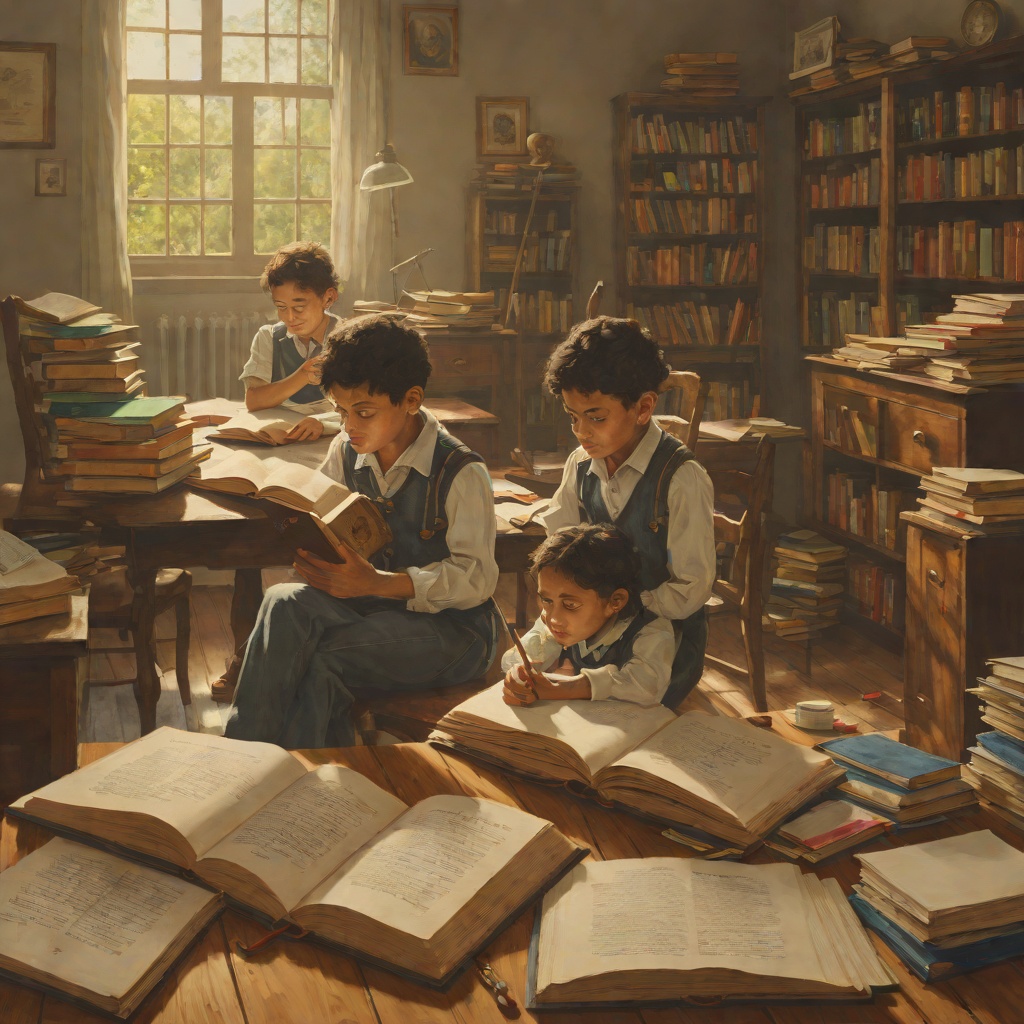
Mary Antin, barred from this world, used to stand in the doorway of her father's store, munching an apple that did not taste good any more, and watch the pupils going home from school in twos and threes. The girls wore neat brown dresses and black aprons and little stiff hats; the boys wore trim uniforms with many buttons. They had ever so many books in the satchels on their backs, and they would take them out at home, read and write, and learn all sorts of interesting things. They looked to her like beings from another world than hers. Yet even those she envied had their own troubles, as she often heard. Their school life was one struggle against injustice from instructors, spiteful treatment from fellow students, and insults from everybody. Those who, by heroic efforts and transcendent good luck, successfully finished the course found themselves against a new wall if they wished to go on: the universities, with their three-to-a-hundred ratio. The quota was a wall within a wall, a barrier that followed the Jewish student from the first day of preparation to the final rejection.
The Contrast with America
The quota stood in stark contrast to the American promise that Mary Antin discovered upon emigration. In America, her father, almost his first act on landing on American soil, had applied for naturalization, and at the earliest moment allowed by the law, he became a citizen of the United States. The boasted freedom of the New World meant to him far more than the right to reside, travel, and work wherever he pleased; it meant the freedom to speak his thoughts, to throw off the shackles of superstition, to test his own fate, unhindered by political or religious tyranny. In America, there was no quota, no special examination for Jewish children, no fear about the turn of one's nose. Instead, there was the public school, where "America" was sung to the same tune as in Chelsea, and geography was made as dark a mystery, but where a Jewish girl could go to school without restriction. The contrast was not merely institutional but moral: in Russia, the state built walls around Jewish ambition; in America, the state opened doors. The quota, in retrospect, became the defining symbol of the old world's tyranny, the thing that made the new world's freedom so precious and so personal.
The Legacy of the Quota
The quota left marks upon the flesh and spirit of the children who grew up under it. Mary Antin remembered little children in Polotzk with old, old faces and eyes glazed with secrets, children who knew how to dodge and cringe and dissemble before they knew the names of the seasons. The quota was part of that education in fear, a lesson in the arbitrariness of power. It taught that the Czar did not want Jews in the schools, and that no amount of brilliance or preparation could overcome that fact. It was a lesson in the helplessness of the Pale, expressed in the shrug of the shoulders and the words, "What can one do? One must live." And it was a lesson that Mary Antin carried with her to America, where she would eventually attend Barnard College, taking all the honors that she deserved, and learning to think in English without an accent. The quota, in the end, was not just a rule but a revelation: it showed what the old world was, and what the new world could be.